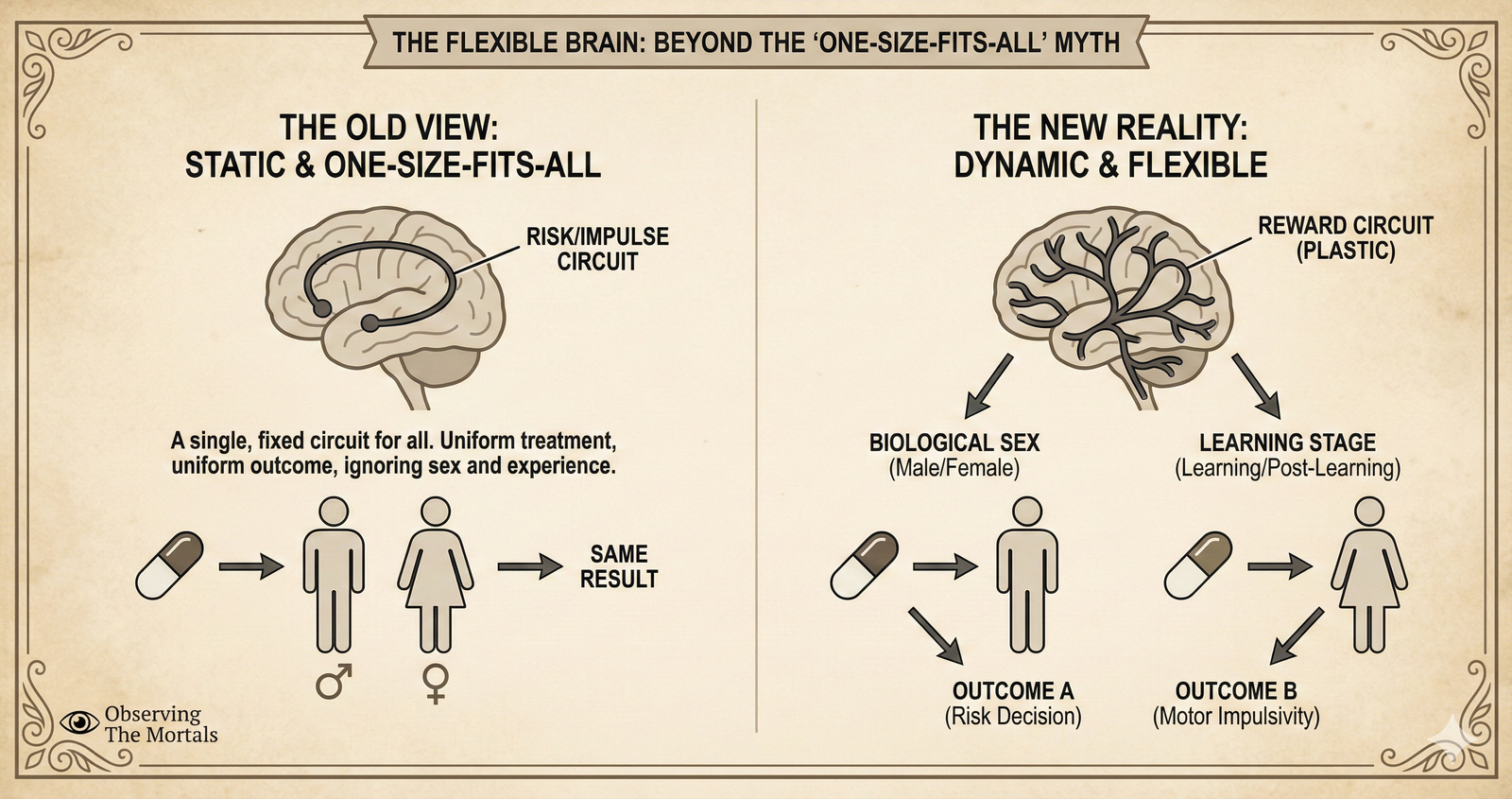
Why do some individuals struggle with addiction or impulsivity while others do not? Why do treatments for these conditions work for some but fail for others? For decades, science has often searched for a single “risk circuit” or a “one-size-fits-all” cure. But a groundbreaking new study from the Journal of Neuroscience reveals that the brain’s reward system is far more complex and dynamic than we imagined. Using a “gambling task” for rats, researchers discovered that the same brain circuit can drive completely different behaviors depending on two crucial, and often overlooked, factors: biological sex and the stage of learning.
The Information Box
Syllabus Connection:
- Paper 1: Chapter 1.7 (The Biological Basis of Life/Behavior), Chapter 9.6 (Medical Anthropology/Psychiatric Anthropology), Chapter 9.6 (Feminist Anthropology)
Key Concepts/Tags:
- Neuroanthropology, Biological Basis of Behavior, Sex Differences, Brain Plasticity, Feminist Anthropology, Androcentrism, Psychiatric Anthropology
The Setting: Who, What, Where?
This case study is based on a neuroscience study led by Tristan Hynes and colleagues from the University of Cambridge and the University of British Columbia. The researchers used a rat model to investigate decision-making. The rats had to choose between four holes that offered different probabilities of a reward (a treat) or a punishment (a time-out). During this “gambling task,” the scientists manipulated a specific reward-related neural circuit and observed the effects on two distinct groups: male and female rats, and at two distinct times, during the learning phase and after the task was already learned.
The Core Argument: Why This Study Matters
This study is a powerful blow against simplistic, “one-size-fits-all” models of brain function and psychiatric treatment.
- Timing and Experience Change a Circuit’s Function: The study’s first major finding is that the brain is not a static machine. The same neural circuit did two different jobs.
- Manipulating the circuit during the learning phase altered the rats’ risky decision-making (i.e., which hole they chose).
- Manipulating the circuit after the learning phase altered their motor impulsivity (i.e., their ability to control their urges). This proves that the function of our brain’s wiring is highly plastic, shifting its role based on experience and learning.
- Biological Sex Fundamentally Alters the Outcome: The second major finding is that the manipulation had sex-specific effects. During the learning phase, the intervention on the reward circuit affected the risky decision-making of male and female rats differently. This provides a clear biological basis for sex differences in how risk, reward, and learning are processed.
- A New Model for Psychiatric Disorders: The combined conclusion is a crucial insight for psychiatric anthropology. It suggests that disorders of impulsivity (like addiction or ADHD) are not a single, static problem. The neural mechanisms will be different in a person just beginning a harmful behavior (the “learning” phase) versus a person with a long-term, habitual disorder (the “post-learning” phase). Furthermore, these mechanisms will respond to treatment differently based on the person’s biological sex.
The Anthropologist’s Gaze: A Critical Perspective
- A Scientific Basis for Feminist Anthropology’s Critique: This study provides the neurological “smoking gun” for a core argument of feminist anthropology. For decades, feminist critics have argued that medical and scientific research is dangerously androcentric (male-biased), often using male subjects as the default and then incorrectly generalizing the results to women. This study provides hard, biological evidence for why that model is scientifically flawed and dangerous, demonstrating that sex differences in the brain are real and have major consequences for health interventions.
- A “Bio-Cultural” Model of the Brain: This research is a perfect example of a bio-cultural (or, in this case, a “bio-experiential”) model. It refutes a simple biological determinism (“it’s just your brain wiring”). It shows that the brain’s function is an emergent property that arises from the dynamic interplay between innate biology (sex) and individual experience (learning). An anthropologist would see this as a model for how culture and experience can, over time, literally reshape the function of our neural hardware.
- Animal Models in Anthropology: Just as primatologists study apes to understand the evolutionary roots of our behavior, physical anthropologists use animal models (like rats) to understand the fundamental, shared mammalian “wiring” that forms the biological basis of our behavior. This study is a classic example of using a simpler model to reveal a complex principle that is highly relevant to humans.
The Exam Angle: How to Use This in Your Mains Answer
- Types of Questions Where It can be Used:
- “Critically evaluate the contribution of feminist anthropology to medical science.”
- “Discuss the biological basis of human behavior, highlighting the role of brain plasticity.”
- “What is the scope of psychiatric anthropology in understanding disorders like addiction?”
- Model Integration:
- On Feminist Anthropology: “Feminist anthropology’s critique of androcentric medical research is strongly supported by modern neuroscience. A 2025 study on reward circuits, for example, found that the same intervention had different effects on risky decision-making in male versus female rats, providing a biological basis for why ‘one-size-fits-all’ treatments for psychiatric disorders often fail.”
- On the Biological Basis of Behavior: “The biological basis of behavior is not static but is a dynamic interplay of biology and experience. A 2025 study on rats showed that the same neural circuit influenced different behaviors—risky decisions vs. motor impulsivity—depending on when it was manipulated (during or after learning), highlighting the brain’s immense plasticity.”
- On Medical Anthropology: “Medical anthropology emphasizes that treatments must be culturally and biologically specific. This is supported by a recent neuroscience study which concludes that treatments for impulsivity must be tailored, as the underlying neural circuits respond differently based on both biological sex and the individual’s stage of learning (i.e., the chronicity of their disorder).”
Observer’s Take
This research is a powerful reminder that the brain is not a simple computer with fixed circuits, but a flexible, living, and dynamic system. It reveals that our behaviors are not the result of a single “on” switch, but of a complex orchestra of factors, including our biological sex and our personal history of learning. The most profound takeaway is the clear, scientific rejection of the “one-size-fits-all” model. To truly understand and treat complex human behaviors like addiction, we must abandon the search for a single, simple answer and embrace a more nuanced approach that respects both our diverse biologies and our unique life experiences.
Source
- Title: (The specific Journal of Neuroscience paper title is not given, but the research is by Hynes et al.)
- Author: Tristan Hynes, et al.
- Publication: Journal of Neuroscience
- News Source: SfN (Society for Neuroscience) / Neuroscience News