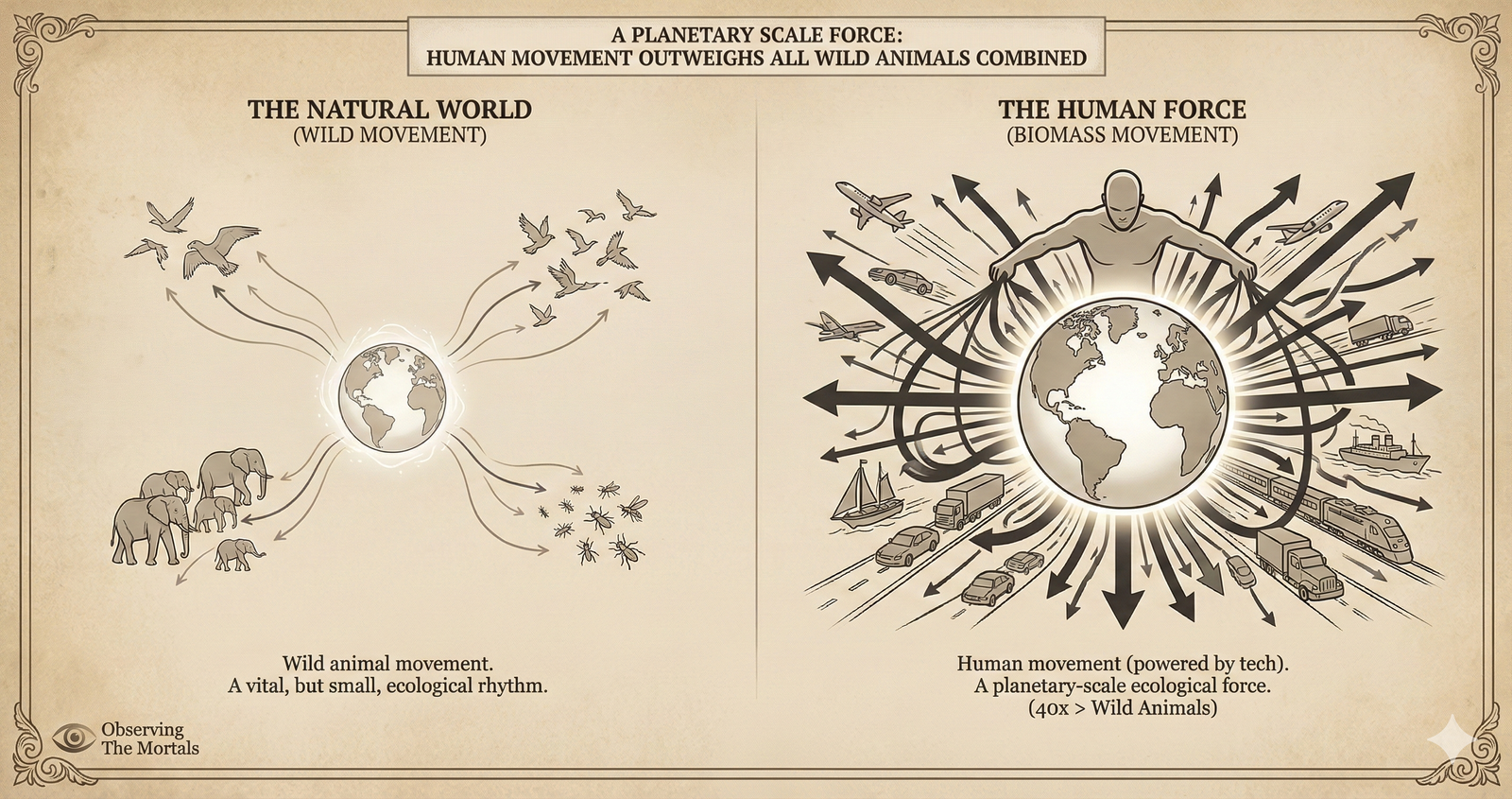
In the story of our planet, the movement of animals—migrations of elephants, flocks of birds—has been a fundamental force shaping ecosystems. But a new, single species has now completely and invisibly eclipsed this ancient rhythm. A groundbreaking study in Nature Ecology & Evolution has quantified, for the first time, the sheer scale of human movement. The finding is staggering: the total “biomass movement” of humanity, powered by our vehicles and planes, is now 40 times greater than all wild land animals, birds, and arthropods combined. This case study explores what this number means, solidifying our role not just as inhabitants of the planet, but as its primary “ecological engineers.”
The Information Box
Syllabus Connection:
- Paper 1: Chapter 10 (Ecological Anthropology: Anthropocene), Chapter 8 (Social Change: Globalization), Chapter 1.2 (Relationship with other disciplines – Ecology)
- GS-3/Essay: Environment, Climate Change, Anthropocene, Human-Environment Relationship
Key Concepts/Tags:
- Biomass Movement, Anthropocene, Ecological Engineering, Planetary Scale Force, Human-Environment Interaction, Technology
The Setting: Who, What, Where?
This case study is based on a major quantitative analysis published in the journal Nature Ecology & Evolution, with key contributions from researchers like Professor Ron Milo of the Weizmann Institute of Science. The study introduces and calculates a new metric: “biomass movement,” defined as a species’ total biomass multiplied by the average distance it travels. The researchers compared the total biomass movement of humans with that of all other land animals, both wild and domesticated, to create a new, objective measure of human impact on the planet.
The Core Argument: Why This Study Matters
This study provides a powerful, new quantitative definition for the Anthropocene, showing that our movement alone is a geological-scale force.
- A New and Startling Metric of Dominance: The core finding is that human biomass movement (at 4,000 Gt/km/yr) is 40 times greater than all wild land animals combined. Even more shocking, it is six times greater than all other land animals, including the billions of domesticated livestock we raise. This provides a clear, undeniable metric of our species’ unprecedented planetary dominance.
- Humans as “Planetary Scale Ecological Engineers”: The authors argue that this massive movement makes humans the most significant “ecological engineers” on Earth. As we move, we are not just passengers; we are fundamentally reshaping ecosystems by transporting nutrients, organisms (invasive species), and pollutants at a scale that dwarfs all natural processes.
- The Role of Technology as a Force Multiplier: The study highlights that this dominance is not a product of our biology, but of our technology. The average human moves 30 km per day, -65% of this in cars and motorcycles and 10% in planes. Our cultural inventions have amplified our species’ physical footprint from a local one to a global, planetary one.
- A Stark Picture of the Anthropocene: The study juxtaposes our “exploded” movement with the fact that the biomass of wild marine animals has halved since 1850. This single comparison perfectly captures the essence of the Anthropocene: as the human system and its proxies (like livestock) expand and accelerate, the wild, natural system contracts and collapses.
The Anthropologist’s Gaze: A Critical Perspective
- From Mobility to Planetary Force: Anthropologists have always studied human mobility—migration, nomadism, trade, and globalization. This study reframes this core anthropological concept. It shows that human mobility is no longer just a social or cultural phenomenon; it has become a geophysical force in its own right, with measurable impacts on the planet’s fundamental trophic and chemical systems.
- The Paradox of Domesticated Animals: An interesting and critical point is that the biomass movement of our domesticated livestock (especially cattle) is of the same order of magnitude as our own. This is a crucial insight. It demonstrates that our ecological footprint is not just our own 8 billion bodies; it is the entire agricultural-industrial complex we have constructed to feed and serve us. Our animals have become an unwilling extension of our own planetary-scale movement.
- A Moral Call to Action (Applied Anthropology): The quote from researcher Ron Milo (“This can help people understand… it also shows we have the power and responsibility to take care of the environment”) is a direct call to Applied Anthropology. The study is not just a doomsday report; it is an argument for conscious, responsible engineering. If we accept our role as the planet’s dominant engineers, we must also accept the ethical responsibility to engineer sustainable, restorative, and just outcomes, not just chaotic, destructive ones.
The Exam Angle: How to Use This in Your Mains Answer
- Types of Questions Where It can be Used:
- “Define the Anthropocene and discuss its key anthropological dimensions.”
- “How has the relationship between humans and the environment changed in the modern era?”
- GS-3/Essay: “Humans have become a ‘planetary scale force.’ Discuss the responsibilities that come with this power.”
- Model Integration:
- On the Anthropocene: “The Anthropocene is defined by human activity becoming the dominant influence on the planet’s systems. A 2025 study on ‘biomass movement’ provided a stark new metric for this, calculating that the movement of human biomass, powered by technology, is now 40 times greater than all wild land animals combined.”
- On Human-Environment Interaction: “The human-environment relationship has been fundamentally altered by technology. While pre-modern societies acted as ecosystem participants, modern humans act as ‘planetary scale ecological engineers.’ A recent study quantified this, showing our species’ ‘biomass movement’ is the single largest force in transporting nutrients and organisms across the globe.”
- For a GS-3/Essay Answer: “Recent scientific reports, such as the one quantifying human ‘biomass movement’ as exceeding all other life, are not just diagnoses of a problem; they are a call for responsibility. If humanity is now the single largest geological and ecological force on Earth, we have a moral and practical obligation to consciously engineer a sustainable, rather than a destructive, future.”
Observer’s Take
We often think of our impact on the planet in terms of what we build (cities, dams) or what we burn (fossil fuels). This study offers a more profound and personal metric: our impact is also in our simple, everyday movement. Every car ride, every flight, every truckload of goods—when multiplied by billions—adds up to a restless, planetary-scale force that is literally reshaping the Earth. It’s a sobering realization that we are no longer just living on the world; we are the primary force moving it. This is the very definition of the Anthropocene, and as the study’s authors note, it hands us an immense responsibility to become conscious and careful stewards of the one and only home we have.
Source
- Title: ‘Human biomass movement exceeds all land animals combined’
- Author: Divya Gandhi
- Publication: The Hindu (reporting on a study in Nature Ecology & Evolution)