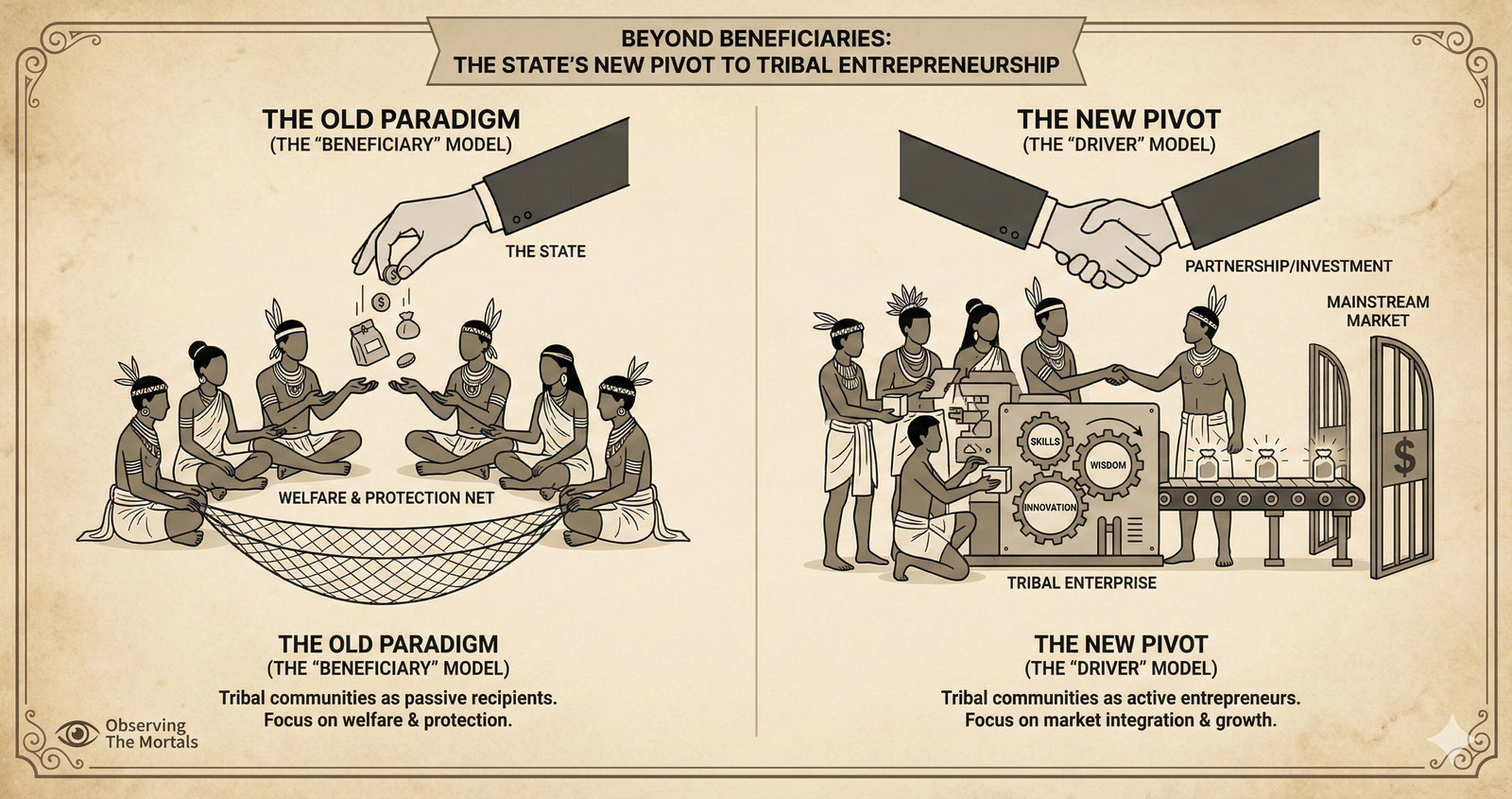
For decades, the dominant image of India’s tribal communities in national policy has been that of “beneficiaries”—a population in need of welfare, protection, and government schemes. A major new government conclave, however, signals a sharp and deliberate break from this narrative. As articulated by the Union Minister for Tribal Affairs, the new conviction is that tribal communities are not just passive recipients, but active “drivers of India’s progress.” This case study explores this significant ideological pivot, analyzing the state’s new focus on “tribal entrepreneurs” and the profound implications of this shift from a welfarist model to one of market integration.
The Information Box
Syllabus Connection:
- Paper 2: Chapter 7 (Role of Anthropology in Tribal Development), Chapter 6.2 (Tribal Administration), Chapter 8 (Social Change: Impact of Modernization, Globalization)
- Paper 1: Chapter 9 (Applied Anthropology), Chapter 3 (Economic Anthropology: Market Integration)
- GS-2/3: Government Policies, Social Justice, Inclusive Growth
Key Concepts/Tags:
- Tribal Development, Applied Anthropology, Market Integration, Welfarism vs. Empowerment, Tribal Entrepreneurship, Neoliberalism, Jual Oram
The Setting: Who, What, Where?
The setting is the Tribal Business Conclave 2025 in New Delhi, an event organized by the Union Ministry of Tribal Affairs as part of the 150th birth anniversary of tribal icon Birsa Munda. The key actor is the Union Tribal Affairs Minister, Jual Oram, who is articulating the new policy vision. The event is explicitly designed to be a “transformative national platform” that moves beyond typical trade fairs (like those by TRIFED) to facilitate “business linkages and attract investments” for tribal entrepreneurs, complete with pitching sessions and exhibitions.
The Core Argument: Why This Study Matters
This case study is a textbook example of a top-down, state-led shift in development paradigm, with three core components.
- A Fundamental Narrative Shift: The most important change is ideological. The state is actively moving to rebrand Adivasi communities from “passive beneficiaries” (a welfarist model) to “active drivers of progress” (an entrepreneurial model). This reframes tribal identity from one defined by marginalization and need to one defined by “skill, wisdom, and resilience.”
- Market Integration as the New Tool: The chosen mechanism for this “driver” role is not state protection, but mainstream market integration. The conclave’s goal is to connect tribal entrepreneurs directly with “mainstream markets or investors,” breaking the old model of isolation. The new metrics for success are explicitly economic: “number of business linkages,” “new enterprises,” and “deeper skills.”
- From Handicrafts to “Honoring the Journey”: The Ministry is deliberately differentiating this conclave from a simple craft fair. By including “knowledge sessions,” “innovation showcases,” and “pitching sessions,” the state is signaling a desire to engage with tribal enterprise at a higher level, focusing on the “journey of tribal enterprises” rather than just the sale of their products.
The Anthropologist’s Gaze: A Critical Perspective
An anthropological lens reveals the profound complexities and potential risks beneath this optimistic new narrative.
- Empowerment or Neoliberal Assimilation?: This is the central anthropological question. Is this a genuine empowerment of tribal agency, or is it a neoliberal policy that simply seeks to assimilate diverse tribal economies into the singular logic of the capitalist market? This approach risks commodifying traditional “wisdom” and “skills,” stripping them of their cultural context and turning them into “investment opportunities.”
- The Risk of Creating a “Tribal Elite”: A critical perspective would ask who benefits from this “entrepreneurial” model. Such a policy may disproportionately favor a small, educated, and well-connected class of “tribal entrepreneurs” who can navigate pitching sessions and investors. This could, in turn, accelerate class stratification within tribal communities, potentially leaving the most marginalized, land-based populations behind.
- A Welcome Rejection of Paternalism: On the positive side, an anthropologist would see this as a significant and welcome break from the colonial and Nehruvian-era “paternalistic” model. The old approach often treated tribal communities as “children” or “museum pieces” that needed to be “protected” by the state. This new language, at least, frames tribal communities as capable, resilient, and agentive economic actors, which is a major shift in official respect.
The Exam Angle: How to Use This in Your Mains Answer
- Types of Questions Where It can beUsed:
- “Critically analyze the shift in government policies for tribal development in the post-liberalization era.”
- “Discuss the impact of market integration on tribal communities and their economies.”
- GS-2: “Evaluate the government’s transition from a welfarist to an empowerment-based approach for vulnerable sections.”
- Model Integration:
- On Tribal Development: “The government’s approach to tribal development is increasingly shifting from a welfarist model to one of market integration. The 2025 Tribal Business Conclave, as articulated by Minister Jual Oram, exemplifies this, reframing tribal communities from ‘beneficiaries’ to ‘drivers of economic progress’ through entrepreneurship.”
- On Market Integration: “While market integration offers potential economic benefits, anthropologists critically analyze its impact. The new policy focus on tribal entrepreneurs, while rejecting old paternalism, risks creating an internal elite and commodifying traditional knowledge without adequate safeguards for the community’s collective social and economic rights.”
- For GS-2: “The government’s shift from a ‘beneficiary’ to a ‘driver of progress’ model for tribal development is a significant ideological change. This empowerment-based approach, however, must be carefully managed to ensure that its benefits are broad-based and do not lead to new forms of inequality or exploitation within these communities.”
Observer’s Take
The shift from “beneficiary” to “driver” is a powerful and long-overdue change in rhetoric, finally moving past a colonial, paternalistic mindset. However, this new embrace of the market is a high-stakes gamble. The market is a tool, and like any tool, it can be used to build or to dismantle. The great challenge for this new policy will be to ensure that “market integration” translates into genuine community empowerment and not just a new, more efficient form of extracting tribal wealth—in the form of skills, knowledge, and resources—for the benefit of the mainstream economy. The line between partnership and predation is a fine one, and it will require more than just conclaves to navigate it justly.
Source
- Title: Tribal communities are not just beneficiaries of govt. schemes, but drivers of India’s progress, says Oram
- Author: Abhinay Lakshman
- Publication: The Hindu