
We all know the classic, “chunkier” face of a Neanderthal—the prominent brow, the large nose, and the powerful, protruding jaw. For decades, this face has been the primary way we’ve visually distinguished “them” from “us.” But the genetic puzzle has always been that our genomes are 99.7% identical. How could such a tiny difference in DNA create such a stark difference in appearance? Now, a groundbreaking new study provides a stunning answer. The secret, it turns out, isn’t in our genes at all, but in the 98% of our DNA we once dismissed as “junk.”
The Information Box
Syllabus Connection:
- Paper 1: Chapter 1.6 (Phylogenetic Status… of Human Fossils: Neanderthals), Chapter 9.4 (Human DNA profiling, gene mapping), Chapter 1.4 (Human Evolution: Principles of Evolution), Chapter 12 (New perspectives: Evo-Devo)
Key Concepts/Tags:
- Neanderthal, “Dark Genome” (Junk DNA), Gene Regulation, Evo-Devo, SOX9 Gene, Zebrafish Model, Phenotype
The Setting: Who, What, Where?
This case study is based on a new study published in the journal Development, led by Dr. Hannah Long. The research team investigated the genetic differences between Homo sapiens and Neanderthals. Instead of looking at the genes themselves, they focused on the “dark genome” (or “junk DNA”)—the vast, non-coding regions of DNA that act as a “control panel,” regulating, activating, and de-activating genes. Specifically, they targeted an enhancer region (EC 1.45) known to control SOX9, a master gene for facial development. To test their findings, they used zebrafish embryos as a model organism, inserting both the human and Neanderthal versions of this enhancer.
The Core Argument: Why This Study Matters
This research provides a precise, elegant mechanism for one of the most famous anatomical differences in human evolution.
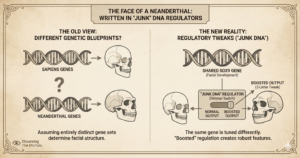
- The Answer is in the “Dark Genome”: The study confirms that the major physical differences between us and Neanderthals are not due to different genetic blueprints, but to different instructions for how to use those blueprints. The key is in the “dark genome,” which acts like a “dimmer switch” for genes.
- A Tiny Change, A Big Effect: The researchers found that the Neanderthal and human versions of this key facial enhancer (EC 1.45) differ by just three letters (Single Nucleotide Variants).
- The “Booster” Effect: When tested in zebrafish embryos, the Neanderthal version of this enhancer showed significantly increased activity. This “boosted” the output of the SOX9 gene, acting like a “volume knob” turned up high during early craniofacial development.
- The Proof (Zebrafish Jaws): To confirm this hypothesis, the team then mimicked this effect by giving zebrafish embryos extra copies of the SOX9 gene directly. The result? The fish developed significantly larger jaws, providing a direct, causal link between the “boosted” gene and the classic Neanderthal trait.
The Anthropologist’s Gaze: A Critical Perspective
- A Perfect Example of “Evo-Devo”: This study is a textbook case of Evolutionary Developmental Biology (Evo-Devo). It powerfully demonstrates that major, species-defining changes in physical form (morphology) are often not caused by the evolution of entirely new genes, but by simple, subtle tweaks in the timing and intensity of existing gene regulation. The Neanderthal face wasn’t a new design; it was the same human design, just with the “volume” turned up.
- The Power of the “Dark Genome”: This research is part of a larger scientific revolution that is redeeming “junk DNA.” Anthropologists are increasingly realizing that this 98% of our genome is not “junk” at all, but a vast, complex “operating system.” It is likely that many of the subtle but crucial differences that define our species—from our faces to our brains—are hidden in these regulatory regions.
- Clinical and Medical Anthropology Links: The study has a direct application in Medical Anthropology. The SOX9 gene and its enhancer region are linked to human facial conditions like Pierre Robin sequence (an underdeveloped lower jaw). By understanding how Neanderthals and humans tinkered with this same “switch,” we can gain a deeper understanding of the genetic basis for these modern human disorders.
The Exam Angle: How to Use This in Your Mains Answer
- Types of Questions Where It can be Used:
- “Critically evaluate the morphological differences between Neanderthals and Homo sapiens.”
- “How have modern genetic techniques (like aDNA and Evo-Devo) revolutionized our understanding of human evolution?”
- “Discuss the concept and significance of ‘junk DNA’ or the ‘dark genome’ in physical anthropology.”
- Model Integration:
- On Neanderthal Morphology: “Recent genetic studies provide the mechanism for classic Neanderthal facial features. A 2025 study showed that just three genetic differences in a ‘dark genome’ enhancer (EC 1.45) ‘boosted’ the activity of the SOX9 gene, leading to the larger, more robust jaw and facial structure seen in Neanderthals.”
- On Evo-Devo: “The difference between Neanderthal and Homo sapiens faces is a prime example of Evolutionary Developmental Biology (Evo-Devo). It was not a change in the primary genes, but a subtle tweak in the regulation of those genes, that led to a major morphological difference, as a 2025 study on the SOX9 enhancer demonstrated.”
- On the Dark Genome: “The 98% of our DNA once called ‘junk’ is now known to be a critical control panel for evolution. A recent study found that the stark difference between a human and a Neanderthal face can be traced back to just three letters in this ‘dark genome,’ which altered the intensity of a key facial development gene.”
Observer’s Take
This is a truly elegant piece of science. It reveals that the difference between our face and a Neanderthal’s is not the result of a vast genetic chasm, but of a subtle tweak to a genetic “dimmer switch.” It’s a humbling reminder that evolution is often a story of subtle changes in regulation rather than massive, brand-new inventions. To think that just three letters, out of a genome of three billion, could be all that separates our facial structure from theirs is a profound lesson in the thriftiness and power of the evolutionary process.
Source
- Title: We Now Know Why Neanderthal Faces Looked So Different To Our Own
- Author: Benjamin Taub
- Original Research: Development (Journal)