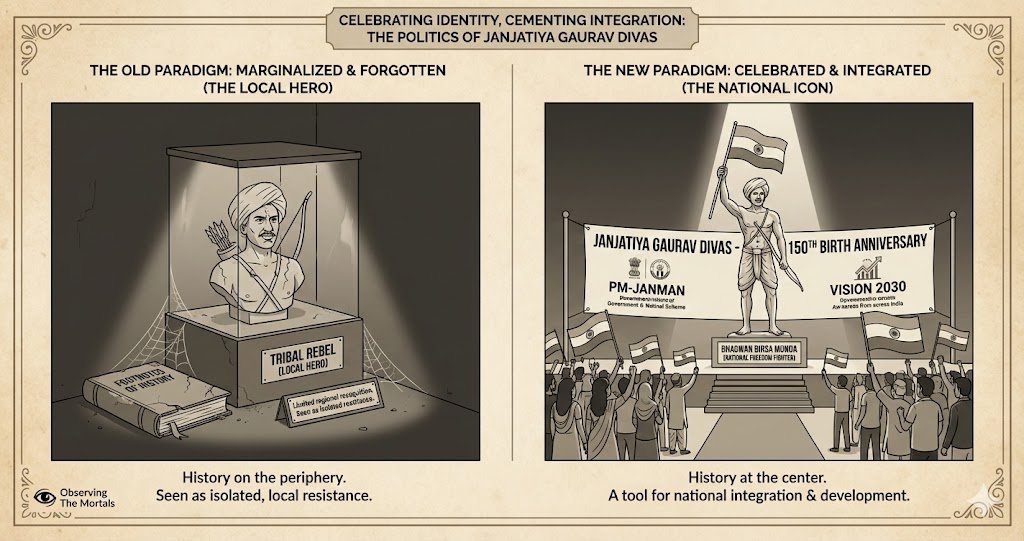
In recent years, November 15th has become a significant date in India’s official calendar. Known as Janjatiya Gaurav Divas (Tribal Pride Day), it marks the birth anniversary of the legendary tribal freedom fighter Birsa Munda. But this is more than just a holiday; it is a strategic state project. A recent directive from the Centre to all States, urging massive, fortnight-long celebrations for Birsa Munda’s 150th birth anniversary, highlights a concerted effort to bring tribal history from the margins to the center. This case study explores how the state uses the “politics of heritage”—celebrating icons, organizing festivals, and launching schemes—as a tool for both cultural recognition and political integration.
The Information Box
Syllabus Connection:
- Paper 2: Chapter 9.3 (Tribal Movements: Birsa Munda), Chapter 6.2 (Tribal Administration), Chapter 1.1 (Contribution of Tribal Culture)
- Paper 1: Chapter 4 (Political Anthropology: State, Nationalism, Politics of Heritage), Chapter 9 (Applied Anthropology)
- GS-1/2: Tribal Culture, Government Policies
Key Concepts/Tags:
- Janjatiya Gaurav Divas, Birsa Munda, Politics of Heritage, Tribal Integration, PM-JANMAN, Cultural Nationalism, Adi Karmayogi
The Setting: Who, What, Where?
The setting is the national governance landscape of India, with the Union Tribal Affairs Ministry directing all State and Union Territory governments to organize massive celebrations from November 1 to 15. The occasion is the 150th birth anniversary of Bhagwan Birsa Munda, the iconic Munda leader who led the Ulgulan (rebellion) against the British. The directive mandates a wide array of activities: from State-level VVIP interactions and painting exhibitions to the promotion of specific schemes like PM-JANMAN (for PVTGs) and Dharti Aba Janjatiya Gram Utkarsh Abhiyan.
The Core Argument: Why This Study Matters
This initiative represents a sophisticated blend of cultural politics and welfare administration.
- The Institutionalisation of Tribal Pride: By mandating state-level celebrations, the government is institutionalising tribal history as national history. It is an attempt to correct the historical erasure of tribal contributions to the freedom struggle. The directive to hold events even in states with Model Code of Conduct (MCC) restrictions (while adhering to rules) underscores the high priority the state places on this narrative of “Janjatiya Gaurav.”
- Culture as a Vehicle for Development: The celebrations are not just ceremonial; they are functional. The government is using the cultural platform of the festival to push its development agenda. The directive explicitly links the celebrations to the display of “Tribal Village Vision 2030” documents and the saturation of PM-JANMAN benefits. This is Applied Anthropology in action: using a cultural event (a festival) to mobilise communities for development goals (housing, health, infrastructure).
- Creating a “Pan-Indian” Tribal Identity: By celebrating Birsa Munda—a leader from the Chotanagpur plateau—across all states and UTs, the state is fostering a unified, pan-Indian tribal identity. It encourages a Naga in the northeast or a Bhil in the west to identify with a Munda hero from the east, thereby weaving diverse tribal groups into a single national fabric of “Janjatiya” identity.
The Anthropologist’s Gaze: A Critical Perspective
- The Politics of “Appropriation” vs. “Recognition”: An anthropologist would analyze the fine line between honoring a community and appropriating its symbols. Is the state celebrating Birsa Munda’s radical ideology of autonomy and land rights (which often challenged the state itself), or is it sanitizing his legacy to fit a nationalist narrative? The focus on “national integration” often downplays the more radical, anti-establishment roots of tribal movements.
- The “Spectacle” of Development: The directive emphasizes “painting exhibitions,” “Adi Haats,” and “cultural programmes.” A critical perspective might ask if this creates a “spectacle” of development that masks deeper structural issues. While celebrating heritage is vital, does it distract from persistent problems like displacement, forest rights violations (as seen in other case studies), and the lack of autonomy in scheduled areas?
- Standardization of Culture: The promotion of specific schemes like “Adi Karmayogi” and standardized “Vision 2030” documents suggests a top-down approach to planning. An anthropologist would caution that true tribal development requires decentralized planning that respects the unique cultural and ecological context of each specific tribe, rather than a one-size-fits-all “vision” rolled out from Delhi.
The Exam Angle: How to Use This in Your Mains Answer
- Types of Questions Where It can be Used:
- “Discuss the role of tribal movements in the Indian freedom struggle and their contemporary relevance.”
- “Analyze the government’s strategy of ‘Tribal Panchsheel’ vs. modern integrationist policies.”
- “How is ‘heritage’ used as a political resource in modern nation-building?”
- Model Integration:
- On Tribal Integration (Paper 2): “The Indian state is increasingly using the ‘politics of heritage’ to integrate tribal communities. The nationwide celebration of ‘Janjatiya Gaurav Divas’ on Birsa Munda’s birth anniversary is a prime example, where the state honors tribal history to foster a sense of national belonging while simultaneously rolling out welfare schemes like PM-JANMAN.”
- On Tribal Movements: “The legacy of tribal movements is being reinterpreted in contemporary India. Birsa Munda’s Ulgulan, originally a rebellion for autonomy and land, is now celebrated as a nationalist freedom struggle through state-sponsored events, highlighting how historical tribal resistance is assimilated into the modern narrative of nation-building.”
- On Development Administration: “Modern tribal administration often blends culture with welfare. The Centre’s directive to link Janjatiya Gaurav Divas celebrations with the saturation of schemes like PM-JANMAN and the display of ‘Tribal Village Vision 2030’ documents demonstrates a strategy of using cultural festivals as platforms for last-mile development delivery.”
Observer’s Take
The celebration of Janjatiya Gaurav Divas is a significant moment of visibility for India’s tribal communities. It validates their history and heroes on a national stage, which is a powerful act of recognition. However, the anthropological eye sees the complexity: this is also a state-building project. By linking the memory of a rebel leader like Birsa Munda to the implementation of central government schemes, the state is attempting to transform a legacy of resistance into a narrative of development and integration. The challenge remains to ensure that in the noise of the celebration, the core demands of Birsa Munda—Jal, Jungle, Zameen (Water, Forest, Land)—are not forgotten.
Source
- Title: Prepare for Janjatiya Gaurav Divas in November, Centre tells States
- Author: Abhinay Lakshman
- Publication: The Hindu