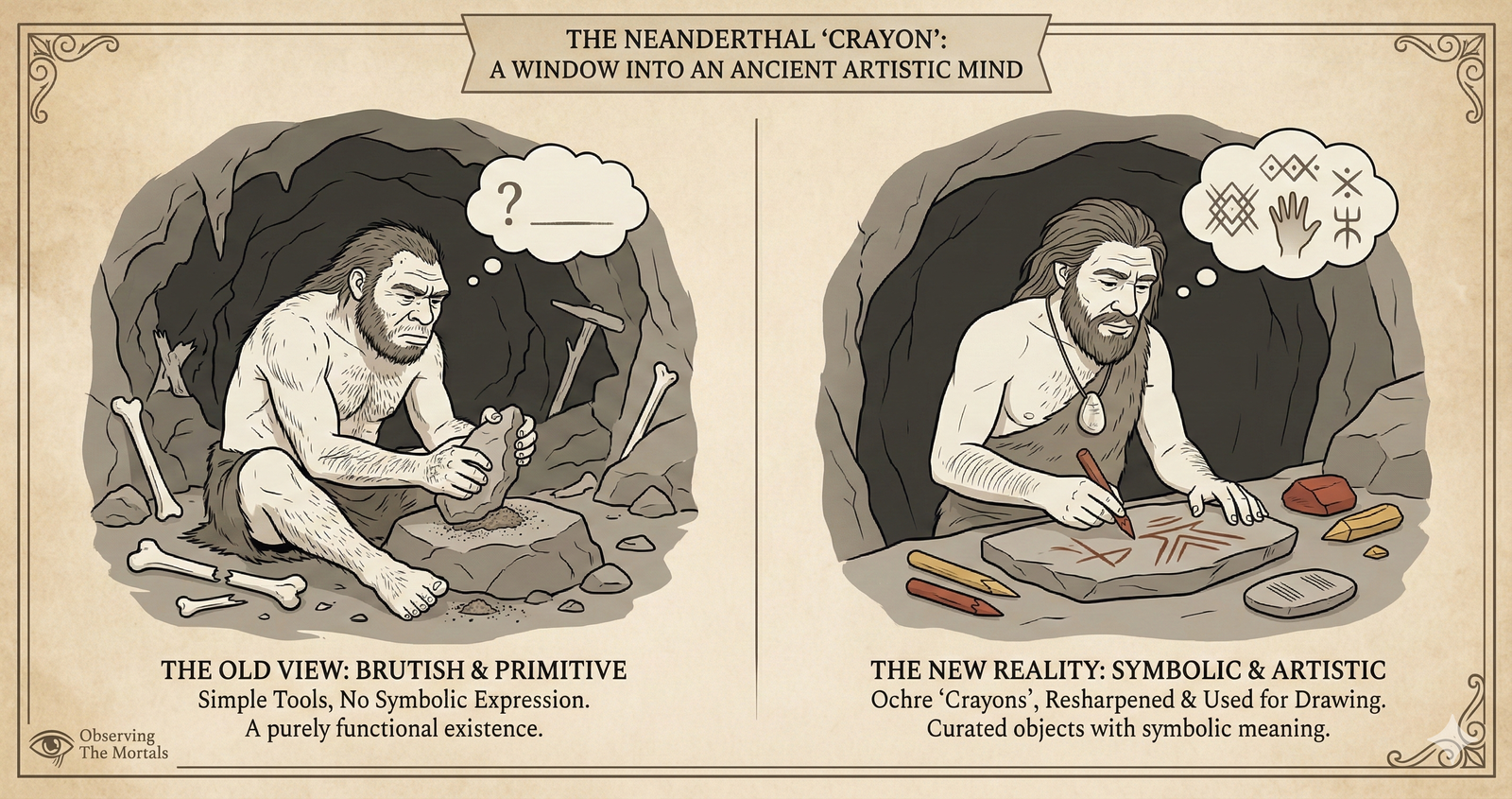
For more than a century, the Neanderthal has been our “brutish” ancestor, the dull, primitive foil to the bright, creative Homo sapiens. We told ourselves that art, symbolism, and complex culture were our exclusive inventions. But a growing body of evidence is shattering this myth, and a new discovery from a Crimean rock shelter adds a remarkably familiar and human detail to the story. By analyzing 47,000-year-old chunks of ocher, scientists have found what they can only describe as “crayons”—tools shaped for drawing, used, and even resharpened, proving that the urge to make art is a deeply ancient human, not just sapiens, trait.
The Information Box
Syllabus Connection:
- Paper 1: Chapter 1.6 (Phylogenetic Status… of Human Fossils: Neanderthal), Chapter 1.8 (Prehistoric Archaeology: Middle Paleolithic Culture, Art), Chapter 1.3 (Archaeological Anthropology)
Key Concepts/Tags:
- Neanderthal, Symbolic Behavior, Ocher Crayons, Middle Paleolithic, Cognitive Evolution, Zaskalnaya V, Blombos Cave
The Setting: Who, What, Where?
The setting is the Zaskalnaya V rock shelter in Crimea, Ukraine, a site occupied by Neanderthals between 100,000 and 33,000 years ago. The artifacts in question are several chunks of ocher, an iron-rich mineral used to create red, orange, and yellow pigments. While archaeologists have long known that Neanderthals used ocher, the assumption was that it was for purely functional tasks like tanning hides or making adhesives. A new study, led by D’Errico and colleagues, used X-ray fluorescence and scanning electron microscopes to analyze the microscopic wear patterns on these ocher pieces, leading to a revolutionary new interpretation.
The Core Argument: Why This Study Matters
This study provides direct, tangible evidence of symbolic behavior, moving the debate from inference to fact.
- It’s a Crayon, Not a Scraper: The key finding is in the wear patterns. The analysis proved these ocher chunks were not just scraped to get powder. Two pieces, one yellow and one red, were deliberately shaped into a crayon-like point and then sanded smooth. Microscopic analysis of the tips showed they were used to draw or mark on a soft surface (like human skin, animal hide, or stone). Most importantly, one piece shows clear marks of being resharpened to maintain its point, just as one would sharpen a modern crayon or pencil.
- It’s Curated Art, Not Just Utility: A third flat piece of ocher was found to have been intentionally engraved with parallel lines. After being carved, the piece was worn and polished smooth, suggesting it was carried around by its owner in a bag for a long time as a curated object. This implies a deep personal or symbolic value far beyond a simple, disposable tool.
- Proving Cognitive Parity: This discovery is a powerful addition to the growing evidence that Neanderthals possessed cognitive flexibility and a capacity for symbolic thought that was equivalent to their Homo sapiens contemporaries. The “brutish caveman” stereotype is, in reality, a 19th-century prejudice, not a scientific reality.
The Anthropologist’s Gaze: A Critical Perspective
- Convergent Cultural Evolution: This find is a powerful example of convergent cultural evolution. We know that Homo sapiens in Africa were using ocher symbolically, most famously with the 73,000-year-old engraved ocher and “drawing kit” from Blombos Cave. This new evidence from Crimea suggests that Neanderthals in Eurasia independently invented and developed their own symbolic traditions, including the technology of “crayons.” The urge to create art appears to be a shared, ancient human capacity, not one that was “gifted” from sapiens to Neanderthals.
- Deconstructing the “Art vs. Utility” Binary: A critical anthropological perspective would challenge our modern, rigid separation of “art” (symbolic) and “utility” (practical). As the study authors note, in many traditional societies, these two functions are inseparable. A Neanderthal might have used this ocher crayon to draw a symbolic pattern while tanning a hide, or to paint a design on their own skin as an insect repellent. The act would be simultaneously practical and deeply meaningful.
- Re-evaluating the Archaeological Record: This study shows how new technologies (like scanning electron microscopes) can force us to re-evaluate evidence that has been sitting in museum drawers for decades. Artifacts that were once dismissed as simple “scrapers” or “pigment sources” are now being revealed as sophisticated tools for symbolic expression. It prompts archaeologists to ask new questions of old collections.
The Exam Angle: How to Use This in Your Mains Answer
- Types of Questions Where It can be Used:
- “Discuss the cultural capacities and ‘modern’ behaviors of Neanderthals.”
- “What is the significance of ocher in Middle Paleolithic cultures?”
- “Analyze the evidence for the origins of art and symbolic behavior in prehistory.”
- Model Integration:
- On Neanderthal Cognition: “The long-held view of Neanderthals as non-symbolic has been definitively overturned by modern archaeological science. A recent study of 47,000-year-old ocher pieces from Crimea revealed they were not just scraped for powder, but were intentionally shaped, used, and resharpened like crayons, providing direct evidence of symbolic and artistic behavior.”
- On Prehistoric Art: “The origins of art are not limited to Homo sapiens. New analyses show that Neanderthals had their own artistic traditions. The discovery of ocher ‘crayons’ in Crimea, for example, suggests a convergent evolution of symbolic tool use, paralleling similar discoveries like those at Blombos Cave in South Africa.”
- To show methodological awareness: “New technologies like microscopic wear analysis are transforming our understanding of the past. Artifacts from Neanderthal sites in Crimea, once thought to be simple pigment sources, are now understood to be sophisticated ‘crayons’ and ‘engraved’ personal objects, forcing a re-evaluation of Neanderthal cognitive abilities.”
Observer’s Take
This discovery is another powerful nail in the coffin of the “brutish” caveman stereotype. The image of a Neanderthal carefully sharpening a yellow ocher crayon to maintain its point is a profoundly human one. It collapses the distance between “us” and “them,” revealing a shared, ancient impulse to mark our world with color and meaning. This isn’t just about a 47,000-year-old art supply; it’s about acknowledging a different kind of humanity, one that was just as complex, creative, and symbolic as our own. The urge to create art, it seems, is one of the deepest instincts of the human family tree.
Source
- Title: Wear marks suggest Neanderthals made ocher crayons
- Author: Kiona N. Smith
- Publication: Ars Technica (reporting on a paper by D’Errico et al.)