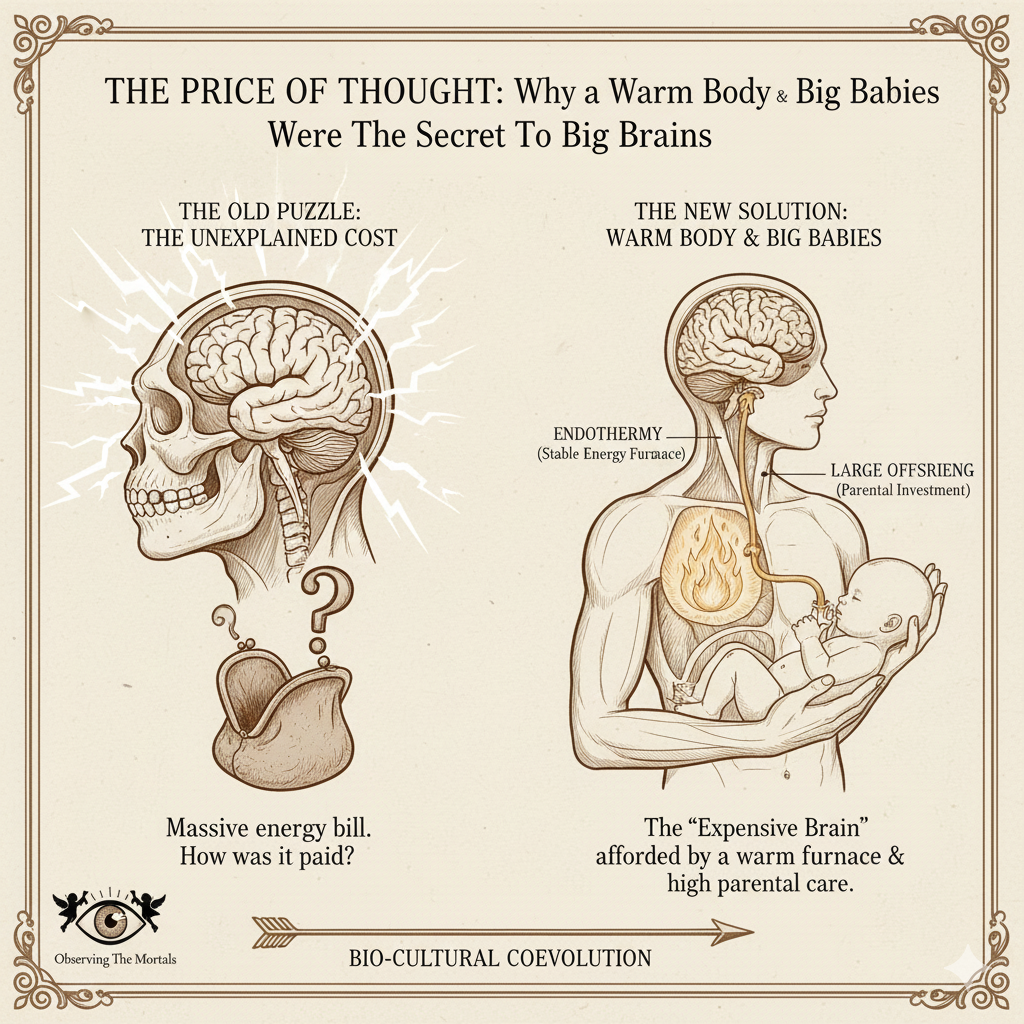
The human brain is an evolutionary masterpiece, but it comes at a staggering price. It is the most “expensive” organ in our body, consuming a massive amount of our daily energy. For decades, a central puzzle in anthropology has been how our ancestors managed to pay this bill, allowing for the evolution of our unique intelligence. A major new study provides a powerful, unifying answer. It wasn’t just about what we ate or how we socialized; it was about two fundamental biological preconditions: a warm body and big babies. This case study explores the “Expensive Brain Hypothesis” and the idea that being warm-blooded was the evolutionary key that unlocked the door to human consciousness.
The Information Box
Syllabus Connection:
- Paper 1: Chapter 1.4 (Human Evolution: Hominid Brain), Chapter 1.5 (Primate Behaviour), Chapter 11.2 (Human Growth and Development), Chapter 11.1 (Human Ecology: Thermoregulation)
Key Concepts/Tags:
- Expensive Brain Hypothesis, Encephalization, Endothermy (Warm-bloodedness), Parental Investment, Human Evolution, Max Planck Institute
The Setting: Who, What, Where?
This case study is based on a large-scale comparative analysis of 2,600 vertebrate species (from fish to mammals) by researchers at the Max Planck Institute for Animal Behavior, published in the journal PNAS. The study, led by Zitan Song and Carel von Schaik, sought to find the key factors that explain the massive, hundredfold variation in brain size across the animal kingdom. The core of their research was to test the “Expensive Brain Hypothesis”—the idea that a big brain can only evolve if an organism can meet its massive and constant energy demands.
The Core Argument: Why This Study Matters
This research provides a clear, two-part explanation for “encephalization” (major evolutionary increases in brain size) and why mammals and birds ended up with the biggest brains.
- The “Warm-Blooded” Precondition (Endothermy): The study’s first major finding is that body temperature is a key driver of brain size. Warm-blooded animals (mammals and birds) can maintain a high, stable internal temperature, which provides the constant, reliable energy supply that a large, “expensive” brain demands. Cold-blooded animals, whose body temperature fluctuates with the environment, cannot guarantee this steady energy flow and are thus constrained to evolving smaller, less energy-intensive brains.
- The “Big Baby” Precondition (Parental Investment): The second key factor is the size of the offspring at birth. The researchers found that species that produce larger, more developed young are able to “afford” to grow larger adult brains. This is because the high energy costs of building a large brain are front-loaded in early development. Species that produce large offspring (often through internal fertilization and feeding the embryo, or matrotrophy) are giving their young the necessary “head start” to manage these early energy costs.
- The Human “Perfect Storm”: The study concludes that humans sit at the pinnacle of this evolutionary trend. We are an “evolutionary perfect storm” for encephalization:
- We are warm-blooded (endothermic), providing the constant, high-energy furnace.
- We have large babies and then engage in prolonged, high-investment childcare (feeding and protecting them for years), which covers the immense energetic cost of growing a massive brain during childhood.
The Anthropologist’s Gaze: A Critical Perspective
- Evolutionary “Spandrels”: This study is a perfect example of what Stephen Jay Gould called an “evolutionary spandrel.” A spandrel is an architectural term for the triangular space created between two arches, which isn’t designed on purpose but becomes a “byproduct” that can then be used for art. Here, warm-bloodedness (endothermy) was the spandrel. It originally evolved for other reasons (like allowing mammals to be active at night), but it unintentionally created the necessary physiological platform that “opened the door” for big brains to evolve later.
- Bio-Cultural Coevolution (Again): This model provides the crucial biological foundation for the bio-cultural coevolution of the human brain. The biological traits of endothermy and parental investment created the potential for big brains. This potential was then likely realized by cultural factors (like complex social groups, tool use, and language), which created the selection pressure for bigger brains. The biological capacity and the cultural need evolved in a feedback loop.
- The “Expensive Brain” as a Constraint: An anthropological perspective would also flip this finding. If a stable energy supply is essential, it explains why hominid brain size stagnated for millions of years. The brains of our ancestors could only begin to expand dramatically once they secured a more reliable, high-energy food source—a key argument for the importance of meat-eating, scavenging, and later, cooking in human evolution. These cultural innovations were the solution to the very energy problem this study identifies.
The Exam Angle: How to Use This in Your Mains Answer
- Types of Questions Where It can be Used:
- “Discuss the major factors and theories related to the evolution of the hominid brain.”
- “Analyze the ‘Expensive Brain Hypothesis’ in the context of human evolution.”
- “How do the principles of human ecology (like thermoregulation) and growth influence our evolutionary trajectory?”
- Model Integration:
- On Brain Evolution: “The evolution of the large human brain is explained by the ‘Expensive Brain Hypothesis.’ A recent Max Planck study across 2,600 species confirmed that two factors were key: endothermy (warm-bloodedness), which provides a stable energy supply, and high parental investment in large offspring, which covers the initial developmental costs.”
- To show a multi-causal approach: “Hominid encephalization was not just a result of a single factor. It required a biological precondition, as a 2025 PNAS study showed: a high, stable body temperature (endothermy). This physiological platform, originally evolved for activity, was an ‘evolutionary spandrel’ that unintentionally opened the door for metabolically-expensive large brains to evolve later.”
- On Human Uniqueness: “Our unique life history—combining our warm-blooded nature with prolonged, high-investment care for large babies—created the perfect energetic conditions for our species to afford the ‘expensive’ brain, allowing us to evolve the largest brain relative to body size of any vertebrate.”
Observer’s Take
This study provides a powerful, unifying answer to one of the biggest questions in our origin story: why us? The answer, it seems, is not just about our intelligence, but about our warmth. The evolution of a constant, internal furnace—the simple biological trait of being warm-blooded—was the accidental key that unlocked our cognitive potential. It was an innovation for activity that became a prerequisite for intelligence. When combined with another deeply human trait—our willingness to invest enormous time and energy into raising our large, helpless young—the evolutionary path was cleared. This research is a beautiful reminder that our most sophisticated cognitive abilities are built on a foundation of the most basic and ancient biological gifts: a warm body and the care of a parent.
Source
- Title: Parental investment and body temperature explain encephalization in vertebrates
- Authors: Zitan Song et al.
- Publication: PNAS (Proceedings of the National Academy of Sciences)
- News Source: Max Planck Institute / Neuroscience News