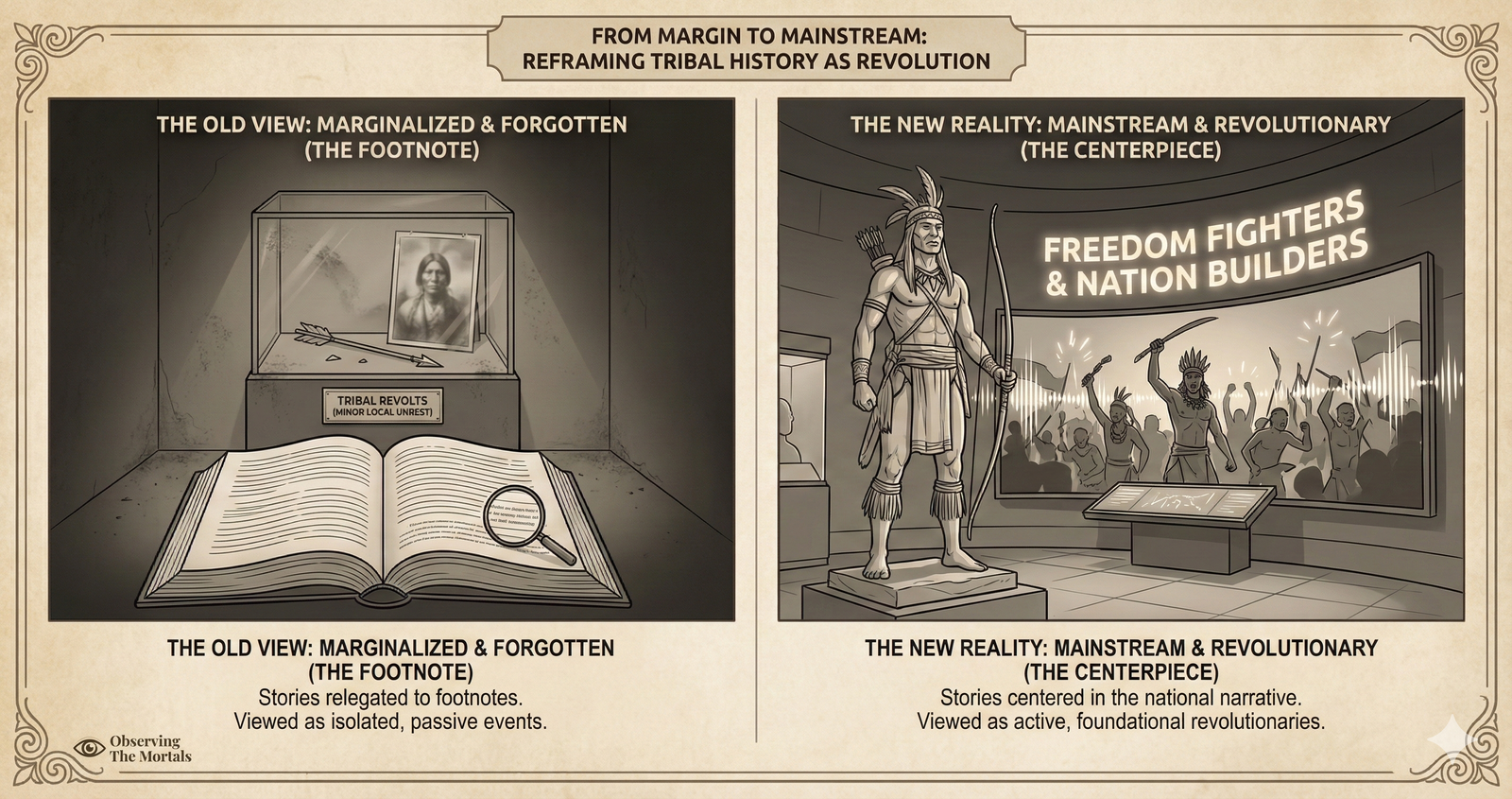
For much of India’s history, the story of its tribal communities has been told as one of isolation, marginalization, or victimhood. Their roles as foundational revolutionaries and freedom fighters have often been relegated to footnotes. Now, a new, state-of-the-art museum in Chhattisgarh is part of a major effort to change that. The “Veer Narayan Singh Memorial & Tribal Freedom Fighter Museum” is not just a collection of artifacts; it is a powerful, modern act of state-sponsored storytelling. This case study explores how this museum is using technology and art to move tribal history from the margins to the very center of India’s national narrative.
The Information Box
Syllabus Connection:
- Paper 2: Chapter 1.1 (Contribution of Tribal Culture to Indian Civilization), Chapter 9.3 (Tribal Movements), Chapter 7 (Role of Anthropology in Tribal Development)
- Paper 1: Chapter 9 (Applied Anthropology: Role in Museums), Chapter 4 (Political Anthropology: State, Nationalism, Politics of Heritage)
- GS-1: Tribal Uprisings in the Freedom Struggle
Key Concepts/Tags:
- Public Anthropology, Politics of Heritage, Applied Anthropology, Tribal Freedom Fighters, Museum Studies, Birsa Munda, Veer Narayan Singh
The Setting: Who, What, Where?
This case study is centered on the new “Veer Narayan Singh Memorial & Tribal Freedom Fighter Museum” located in Nava Raipur, Chhattisgarh. The ₹53 crore project, implemented by the state’s Tribal Welfare Department, is a large-scale, high-tech institution. It uses life-sized sculptures (including 300 from Sangli), digital dioramas, animated videos, and a mini-theatre to showcase the lives and struggles of numerous tribal heroes, including Veer Narayan Singh, Birsa Munda, Gundadhur, and Ramad Gond. The museum’s opening is part of a broader national push, coinciding with the 150th birth anniversary of Birsa Munda (celebrated as Janjatiya Gaurav Divas).
The Core Argument: Why This Study Matters
This museum is a significant contemporary case study in the state’s use of public history and applied anthropology to reshape a national narrative.
- A Deliberate Narrative Shift: The core purpose of the museum is to enact a profound narrative shift. It moves tribal communities from their traditional portrayal as “passive beneficiaries” of government schemes to that of “active agents” and “revolutionaries” who played a central, patriotic role in the nation’s struggle for independence.
- Public Anthropology in Action: This is a textbook example of Applied or Public Anthropology. It is the use of anthropological and historical knowledge (artifacts, life stories, cultural details) in a public-facing institution (a museum) to achieve a specific social goal—in this case, to educate a wider audience, instill pride, and correct a historical erasure.
- Modern Museology for a New Generation: The project is notable for its deliberate use of modern technology. By employing “digital experiences,” “dioramas,” and “animated videos,” the state is ensuring that these stories are not just archived, but are presented in an engaging and accessible format. This is a conscious move away from the “dusty artifact” model of museums and towards an immersive storytelling experience.
The Anthropologist’s Gaze: A Critical Perspective
- The “Politics of Heritage”: An anthropologist would immediately analyze this as a case of the “politics of heritage.” The state is the one curating this narrative. This involves a process of selection: Which heroes are chosen? (e.g., Veer Narayan Singh). Which stories are told? (e.g., anti-British struggles). This is a political act of creating a “usable past” that aligns with a specific vision of national unity.
- “Nationalizing” Tribal Resistance: A critical perspective would question the framing. The museum portrays these figures as Indian freedom fighters. An anthropologist might ask: Were these leaders (like Birsa Munda) fighting for “India,” or were they fighting to protect their own tribal autonomy (bir, disom, or “realm”) from all outside forces, including both the British and the non-tribal dikus (outsiders)? The museum’s narrative likely “nationalizes” what were often deeply local, autonomous, anti-colonial, and anti-feudal struggles.
- Commodification vs. Dignity: Like any state-sponsored cultural project, this walks a fine line. Is it a genuine effort to restore dignity and correct the historical record? Or is it a form of “ethno-tourism” and political branding, designed to package tribal history for mainstream consumption? The answer is likely a complex mix of both, but the act of officially validating these histories in a state-of-the-art facility is itself a significant political statement.
The Exam Angle: How to Use This in Your Mains Answer
- Types of Questions Where It can be Used:
- “Discuss the contribution of tribal communities and their leaders to the Indian freedom struggle.”
- “What is the role of the anthropologist in a museum? Discuss with reference to the representation of tribal culture.”
- “Analyze the nature and causes of tribal movements in India.”
- Model Integration:
- On Tribal Contributions (Paper 2/GS-1): “The contribution of tribal freedom fighters is being increasingly recognized in the national narrative. A prime example is the new ‘Veer Narayan Singh Memorial & Tribal Freedom Fighter Museum’ in Chhattisgarh, a state-sponsored project using modern technology to showcase the legacies of leaders like Birsa Munda and Gundadhur.”
- On Applied Anthropology (Paper 1): “Applied anthropology in museums is crucial for ‘public history.’ The new tribal museum in Raipur demonstrates this, using digital dioramas and sculptures to translate ethnographic and historical data into an accessible public narrative that reframes tribal communities as ‘revolutionaries’ rather than passive victims.”
- On the Politics of Heritage: “The ‘politics of heritage’ involves a selective process of remembering. The creation of a state-funded museum for tribal freedom fighters in Chhattisgarh is a powerful political act that officially validates and “nationalizes” their anti-colonial struggles, integrating subaltern histories into the mainstream narrative of Indian independence.”
Observer’s Take
The new museum in Chhattisgarh is a powerful and necessary step. For too long, the stories of Adivasi resistance have been whispers in the margins of our official history. This project, by building a modern, high-tech “temple” to these memories, is a loud and clear declaration that tribal history is Indian history. From an anthropological perspective, it is a fascinating case of the state acting as a storyteller—curating a specific, heroic past to inspire a more inclusive future. The critical challenge, as always, is to ensure that in this process of “nationalizing” these heroes, their unique, local, and often radical voices are not lost, but amplified.
Source
- Title: New museum in Chhattisgarh shines spotlight on tribal freedom fighters
- Author: Jayprakash S Naidu
- Publication: The Indian Express