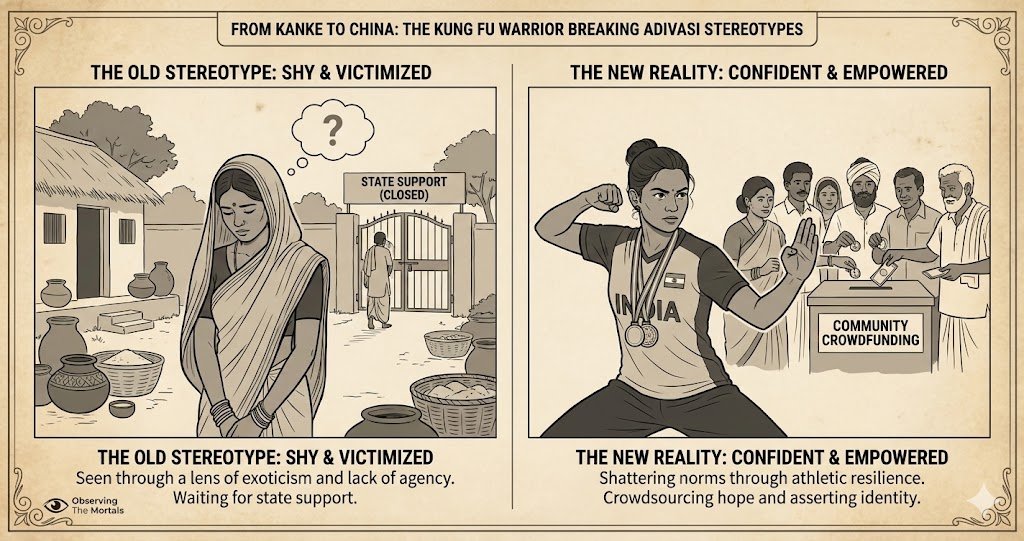
In the popular imagination, tribal women are often depicted through a lens of shyness, exoticism, or victimization. Purnima Linda, a young woman from the Oraon tribe in Jharkhand, shatters this image with a single kick. Having recently won two bronze medals at the World Kungfu Championships in China, her journey from a small village to the global arena is not just a sports story. It is a profound narrative of resilience, where “rural survival” translates into athletic strength, and where a community crowdsources hope in the absence of state support. This case study explores how sports can become a vehicle for identity assertion and the harsh reality of “selective nationalism” that athletes from marginalized communities often face.
The Information Box
Syllabus Connection:
- Paper 2: Chapter 6.1 (Problems of Tribal Communities: Poverty, Unemployment), Chapter 8 (Social Change: Status of Women), Chapter 9.3 (Tribal assertion)
- Paper 1: Chapter 2.2 (Social Stratification: Gender), Chapter 9 (Applied Anthropology: Sports Anthropology)
Key Concepts/Tags:
- Oraon Tribe, Gender Stereotypes, Sports Anthropology, Selective Nationalism, Crowdfunding, Social Mobility, Agency
The Setting: Who, What, Where?
The protagonist is Purnima Linda, a 30-year-old athlete from the Oraon tribe in Kanke village, Jharkhand. The daughter of an Anganwadi worker and a daily wager, she qualified for the World Kungfu Championships (Wushu) in Emeishan, China. Despite having no steady job and facing severe financial constraints, she managed to participate and win two bronze medals. Her journey stands in stark contrast to the lack of institutional support, relying instead on her family and village network.
The Core Argument: Why This Study Matters
This case study highlights the complex intersection of tribal identity, gender, and the state.
- Crowdsourcing Hope (Community vs. State): Purnima’s participation was not funded by the government but by her community. She crowdfunded ₹1.5 lakh from family, villagers, and fellow athletes. This highlights a critical governance failure where talent from marginalized communities is left to fend for itself, relying on traditional social capital (community bonding) rather than state infrastructure.
- Shattering the “Shy Adivasi” Stereotype: Purnima explicitly articulates how Wushu reshaped her identity. She states, “It breaks gender norms and boosts confidence, countering the stereotype that Adivasi women are shy.” This is an act of cultural assertion. She is actively rewriting the script of what it means to be an Adivasi woman—moving from a passive subject to a combative, victorious agent.
- The “Rural Survival” Advantage: When asked about her diet, she laughs and mentions “rural survival” as her source of strength rather than expensive protein supplements. This points to the embodied resilience of tribal life. The physical hardships of rural existence are repurposed here as athletic capital, challenging the notion that “development” (in the form of fancy facilities) is the only path to success.
The Anthropologist’s Gaze: A Critical Perspective
- The Critique of “Selective Nationalism”: Purnima offers a sharp political critique. She notes that when she won against Pakistan previously, she was celebrated, but her win in China garnered less attention. She observes, “Nationalism often appears selectively, depending on the opponent.” An anthropologist would analyze this as the politics of performance—where an athlete’s value is determined not just by their skill, but by how well their victory fits into the prevailing nationalist narrative of the time.
- Sports as a Precarious Path to Mobility: For Purnima, medals are a means to an end: “She now has one focus: to find a government job.” This highlights the precarious nature of social mobility for tribal youth. Sports is seen as a desperate exit strategy from poverty. The tragedy lies in the fact that despite international accolades, the basic economic security of a “Class 4 job” remains elusive, reflecting the structural barriers that even champions cannot easily jump over.
- Matrilineal Support in a Patriarchal World: The role of her mother is central. “My mother has been my partner in my journey,” she says. From selling Hadia (rice beer) to working as a Sevika, her mother’s labor financed this dream. This underscores the often-overlooked role of women’s economic contribution in tribal households, which frequently anchors the family’s aspirations.
The Exam Angle: How to Use This in Your Mains Answer
- Types of Questions Where It can be Used:
- “Discuss the changing status of tribal women in India.”
- “Analyze the problems of tribal communities with specific reference to youth and employment.”
- “Sports can be a powerful tool for social change and identity assertion. Discuss.”
- Model Integration:
- On Tribal Women: “Tribal women are increasingly breaking traditional stereotypes. Purnima Linda, an Oraon athlete from Jharkhand who crowdsourced her way to winning medals at the World Kungfu Championships, exemplifies this agency, using sports to counter the ‘shy Adivasi woman’ narrative.”
- On Problems of Development: “Despite the rhetoric of tribal development, structural support often fails the most talented. The case of Purnima Linda, who had to rely on community funding rather than state sponsorship to represent India, highlights the persistent gap between policy promises and the grassroots reality for tribal youth.”
- On Identity: “Sports acts as a modern arena for identity construction. For Purnima Linda, Wushu was not just a sport but a tool to reshape her identity and resist gender norms, illustrating how tribal youth negotiate modernity to assert their place in the world.”
Observer’s Take
Purnima Linda’s story is a double-edged sword. It is undeniably inspiring, a testament to the indomitable spirit of an individual and the solidarity of a village. But it is also a shaming indictment of the system. When a national champion has to rely on her mother selling rice beer to afford a ticket to represent her country, we must ask: who are we really cheering for? Purnima has fought her way to the podium, but her fight for basic economic dignity continues. Her bronze medal shines, but it reflects the harsh, unpolished reality of a system that loves the victory but often neglects the victor.
Source
- Title: From Kanke to China: How an Adivasi athlete fought odds to win medals
- Author: Shubham Tigga
- Publication: The Indian Express