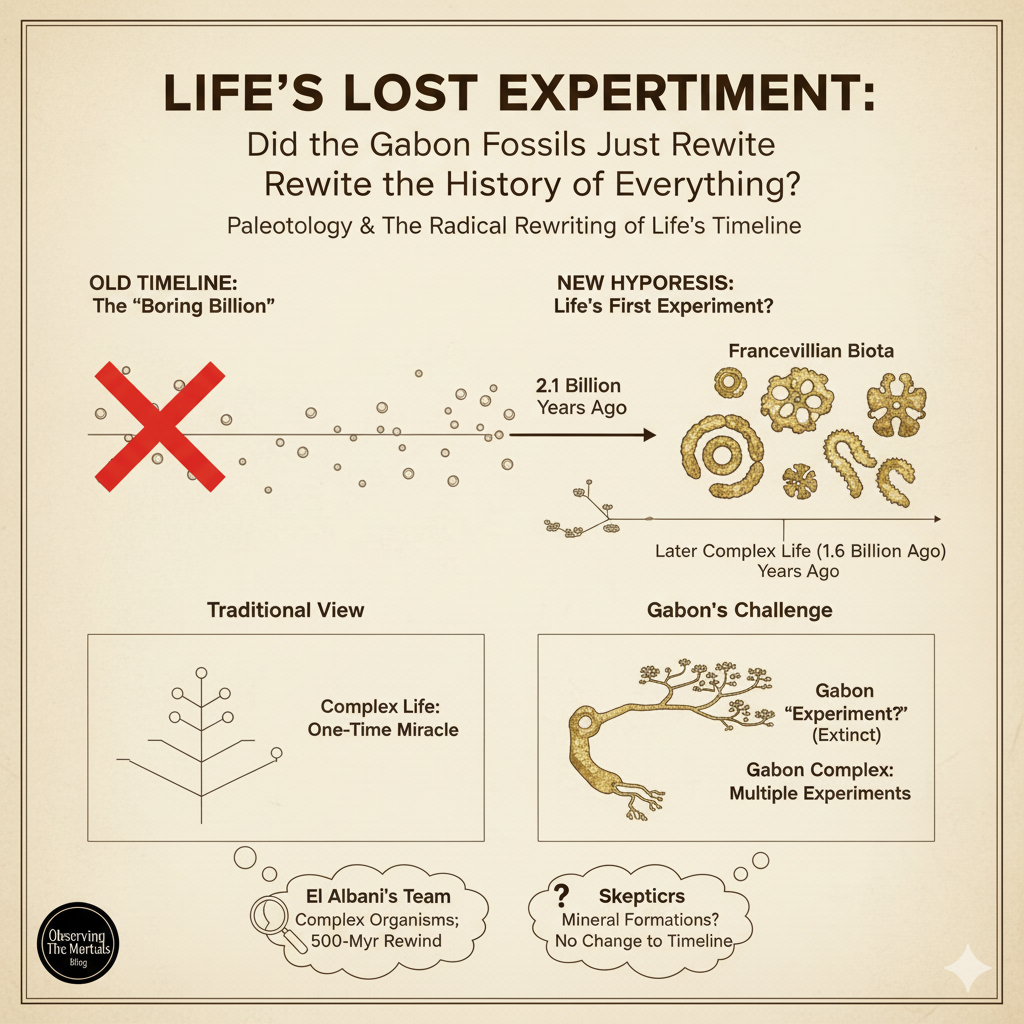
The story of life on Earth has a sacred timeline, a grand narrative that every biology student learns. A key chapter in that story is the “boring billion,” a long, static period before the first complex, multicellular creatures finally emerged around 1.6 billion years ago. But in a quarry in Gabon, West Africa, thousands of bizarre, gleaming fossils have been unearthed that threaten to tear up this chapter and rewrite the entire book. Dated to over 2.1 billion years old, these strange shapes suggest that complex life on our planet may not have been a one-time miracle, but a bold “experiment” that arose, and perhaps vanished, long before we ever thought possible.
The Information Box
Syllabus Connection:
- Paper 1: Chapter 1.7 (The Biological Basis of Life), Chapter 1.4 (Principles of Evolution), Chapter 1.3 (Scope & Relevance of Paleoanthropology/Paleontology)
Key Concepts/Tags:
- Origins of Life, Multicellularity, Francevillian Biota, Paleoanthropology, Scientific Controversy, Abderrazak El Albani, Gabon Fossils
The Setting: Who, What, Where?
The setting is a 2.14-billion-year-old black shale deposit near the town of Franceville in Gabon. The key actor is geologist Abderrazak El Albani, who, since 2008, has discovered and analyzed over 6,000 unusual specimens. He and his team argue that these are not random mineral shapes but the pyritized fossils of the oldest known complex multicellular organisms on Earth, a group now sometimes referred to as the Francevillian biota. The discovery has ignited a major scientific controversy, pitting El Albani’s team against other prominent paleontologists who remain deeply skeptical.
The Core Argument: Why This Study Matters
This is a potentially paradigm-shifting discovery that challenges the very foundations of evolutionary biology.
- A 500-Million-Year Rewind: The most immediate and dramatic implication is that the timeline for the origin of complex multicellular life would have to be pushed back by at least 500 million years. This is not a minor adjustment; it is a radical rewriting of the early history of life.
- Life as a “Series of Experiments”: The traditional view is that complex multicellularity was an incredibly difficult evolutionary hurdle that was cleared only once. El Albani’s discovery suggests a more dynamic and perhaps more probable story: that complex life may have evolved multiple times, independently. The Gabon organisms would represent a completely separate, earlier “experiment” in multicellularity that ultimately failed and went extinct, leaving no descendants.
- A Lost Branch on the Tree of Life: If El Albani is correct, these fossils represent an entirely new and unknown form of life. He speculates they might have been colonial eukaryotes, perhaps resembling a slime mold, that are completely unrelated to the lineage that eventually led to animals, plants, and fungi. They are a lost branch of the tree of life.
The Anthropologist’s Gaze: A Critical Perspective
- The Anthropology of Science in Action: This case study is a perfect, real-time example of the scientific method and the sociology of scientific knowledge. It’s a story of a bold claim based on new evidence, followed by intense skepticism and the proposal of alternative, more conventional explanations (they are natural mineral formations or simple bacterial mats). This process of debate, controversy, and the demand for more evidence is how scientific knowledge is actually produced and validated.
- Challenging Linear Models of Evolution: This discovery, if confirmed, is a powerful blow against a simplistic, linear, and progress-oriented view of evolution. The old story is one of a slow, steady climb from simple to complex. The Gabon fossils suggest a more “bushy” and experimental model of evolution, with multiple starts, dead ends, and “failed experiments” along the way.
- The “Fossil” as a Contested Object: An anthropologist of science would focus on the very definition of a “fossil.” The debate shows that a fossil is not a self-evident object. Its meaning is constructed through interpretation. For El Albani’s team, the gleam of pyrite reveals a complex organism. For the skeptics, it reveals a natural process of mineral accretion. The object is the same; the interpretation creates two completely different realities.
The Exam Angle: How to Use This in Your Mains Answer
- Types of Questions Where It can be Used:
- “Discuss the major theories on the origin of life.”
- “The story of evolution is one of constant revision based on new evidence. Discuss with examples.”
- GS-3 (Science & Tech): “How do new fossil discoveries and scientific controversies shape our understanding of life on Earth?”
- Model Integration:
- On the Origin of Life: “Our understanding of the origin of complex life is constantly being challenged. The discovery of the 2.1-billion-year-old Francevillian fossils in Gabon, for example, has proposed the radical hypothesis that multicellularity may have evolved multiple times, half a billion years earlier than previously thought.”
- On Evolutionary Theory: “New discoveries often challenge linear, progressive models of evolution. The Gabon fossils, if confirmed as complex organisms, would suggest a more experimental model of life’s history, with multiple independent origins and subsequent extinctions of complex life, rather than a single, successful event.”
- For a GS-3 Answer: “Major scientific advances are often born from controversy. The debate over the Gabon fossils—whether they are the world’s oldest complex organisms or merely natural mineral formations—is a powerful example of the scientific method at work, where extraordinary claims require extraordinary evidence and rigorous peer review.”
Observer’s Take
The gleaming fossils of Gabon are a profound and tantalizing puzzle. They ask us to consider a radical reimagining of the story of life. What if the evolutionary path that led to us was not the only one? What if the Earth was once home to other, completely alien experiments in complex life that bloomed for a time and then vanished without a trace? Whether the Gabon specimens are ultimately proven to be true fossils or a geological illusion, their very existence has already served a crucial purpose. They have forced science to confront the limits of its knowledge and to once again ask the biggest questions of all: How did we get here, and was it inevitable?
Source
- Title: The World’s Oldest Fossils of Complex Life Are in a Class of Their Own
- Publication: This appears to be a synthesis of information, with the primary researcher being Abderrazak El Albani, whose work has been published in journals like PLOS ONE and Nature.